
Natural Resources
In this scheme, children learn what natural resources are and how they are used in everyday life. They explore how resources are distributed around the world and why countries trade to access what they need. Through fieldwork, children observe and record how natural resources are used in their local area, then analyse their findings to identify patterns and explain why they occur. Finally, they compare their local area with coastal, rural and urban environments, explaining how and why resource use differs between places.
Each of the seven fully prepared lessons comes with a detailed plan, a set of engaging and informative PDF slides for the teaching input, differentiated activity ideas and printable resources to support your class during their independent work.
A Knowledge Organiser is available to support the learning in this scheme. It is included in the Complete Series download or can be purchased individually.
Lesson 1: What are Natural Resources?
In this lesson, children are introduced to natural resources and learn how they are used by people. They explore different types of natural resources, including renewable and non-renewable, and begin to group them in different ways.
In their independent activities, children apply their understanding by identifying and classifying natural resources in a real-life environment, or in the alternative activity, compare and evaluate their importance through a ranking and discussion task.
This Natural Resources KS2 lesson pack includes a detailed plan, a set of informative PDF slides for the teaching input, differentiated activity ideas and printable resources to support your class in their independent tasks.
What's included:
- Lesson plan
- Slides
- Activity ideas
- Photo Card
- Information Card
- Differentiated worksheets
- Resource Cards and Discussion Stems
- Sorting Sheet
Lesson 2: Uneven Distribution
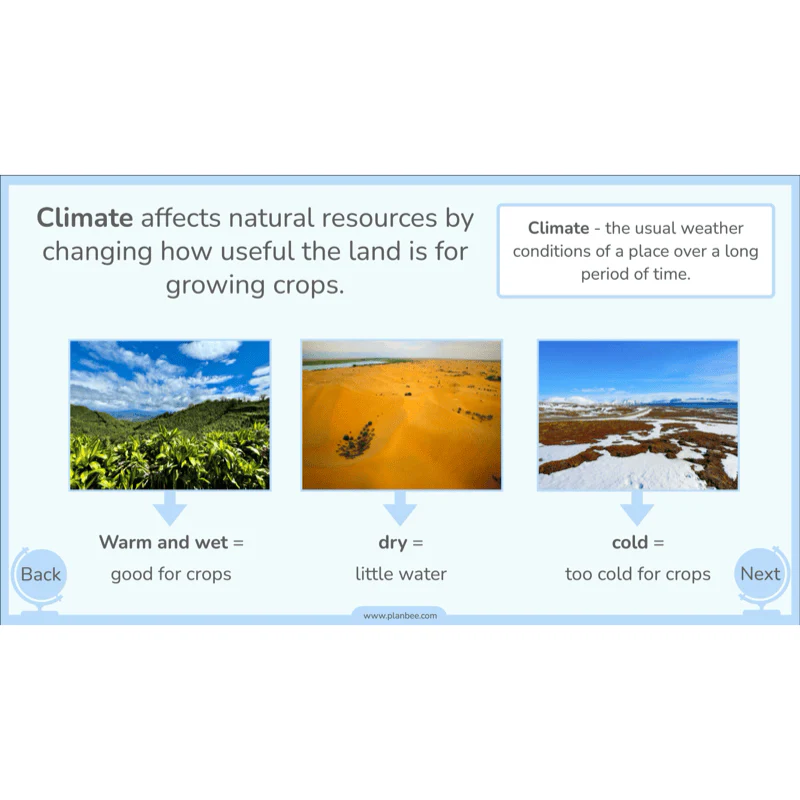
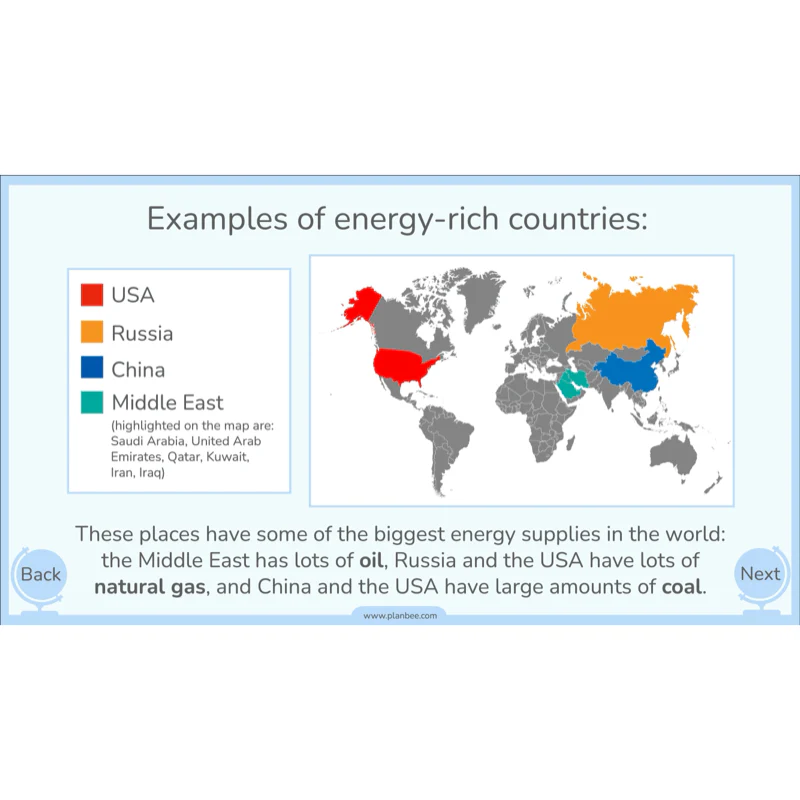
In this lesson, children explore how natural resources are distributed around the world and why they are not found everywhere. They learn about different types of resources and how factors such as climate, geology and environment affect where they are found.
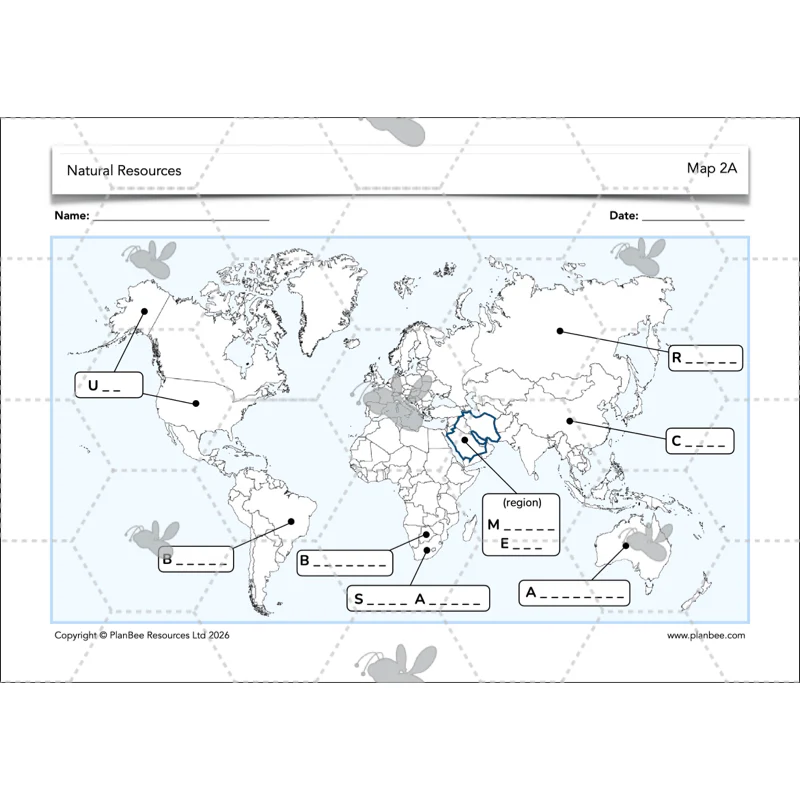
In their independent activities, children apply their understanding by locating and analysing resource distribution on a world map, or by sorting and matching cards to explain patterns through discussion and reasoning.
This downloadable KS2 Natural Resources lesson pack has everything you need: an easy-to-follow plan, engaging PDF slides for the teaching input, differentiated activity ideas, including an alternative activity, plus printable resources.
What's included:
- Lesson plan
- Slides
- Activity ideas
- Information Sheet
- Map Sheets
- Differentiated worksheets
- Resource and Factor Cards
Lesson 3: Trade around the World
In this lesson, children learn why countries trade natural resources and how this is linked to the uneven distribution of resources around the world. They explore what different countries have and need, and how this leads to imports and exports.
In their independent activities, children apply their understanding by planning and explaining trade between countries, or by taking part in a trading activity to negotiate and justify trade decisions through discussion.
A detailed lesson plan, a set of engaging and informative PDF slides, differentiated activity ideas and printable resources are all included in this ready-to-teach KS2 Geography lesson pack.
What's included:
- Lesson plan
- Slides
- Activity ideas
- Differentiated worksheets
- Country Cards
- Trade Deal Cards
Lesson 4: UK Trade
In this lesson, children learn about how the UK trades natural resources and why it relies on other countries. They explore what the UK imports and exports and how factors such as climate and availability affect this.
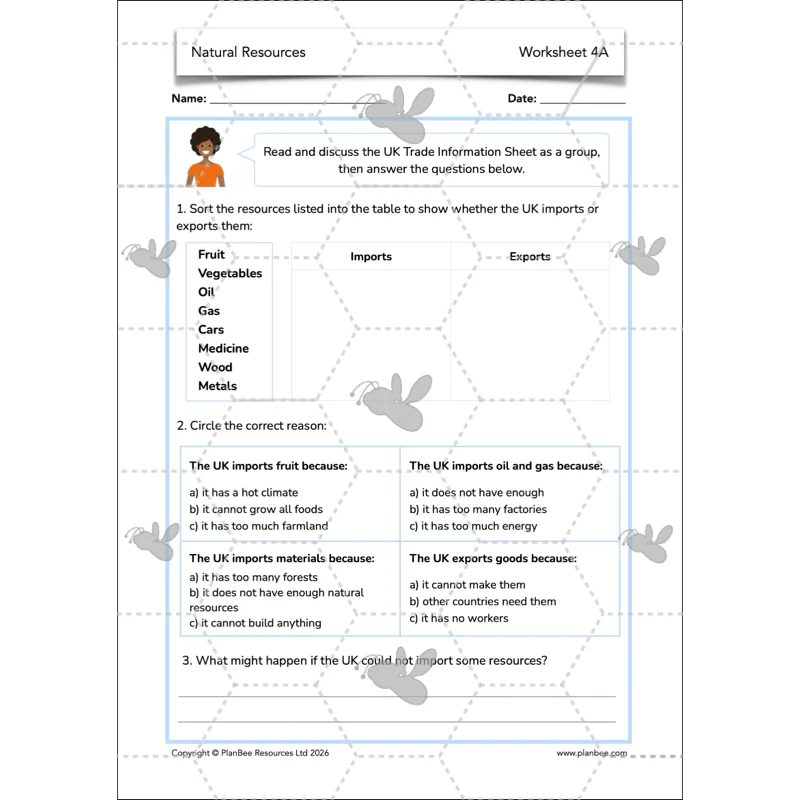
In their independent activities, children apply their understanding by explaining UK trade and its importance, or by discussing and justifying ideas about trade through structured group discussion.
This UK Trade KS2 lesson pack includes a detailed plan, a set of informative PDF slides for the teaching input, differentiated activity ideas and printable resources to support your class in their independent tasks.
What's included:
- Lesson plan
- Slides
- Activity ideas
- UK Trade Information Sheet
- Differentiated worksheets
- Discussion Cards
Lesson 5: Carrying out Fieldwork
In this lesson, children use fieldwork to explore how natural resources are used in their local area. They learn to identify different types of land use and observe how natural and human features are linked to the use of resources.
In their independent activities, children apply their understanding by recording observations in the local area, or by discussing and sorting photo cards to explain how natural resources are used in different places.
This downloadable KS2 Fieldwork lesson pack has everything you need: an easy-to-follow plan, engaging PDF slides for the teaching input, differentiated activity ideas, including an alternative activity, plus printable resources.
What's included:
- Lesson plan
- Slides
- Activity ideas
- Fieldwork Recording Sheets
- Teacher Notes
- Discussion Instruction Cards
Lesson 6: Analysing Fieldwork
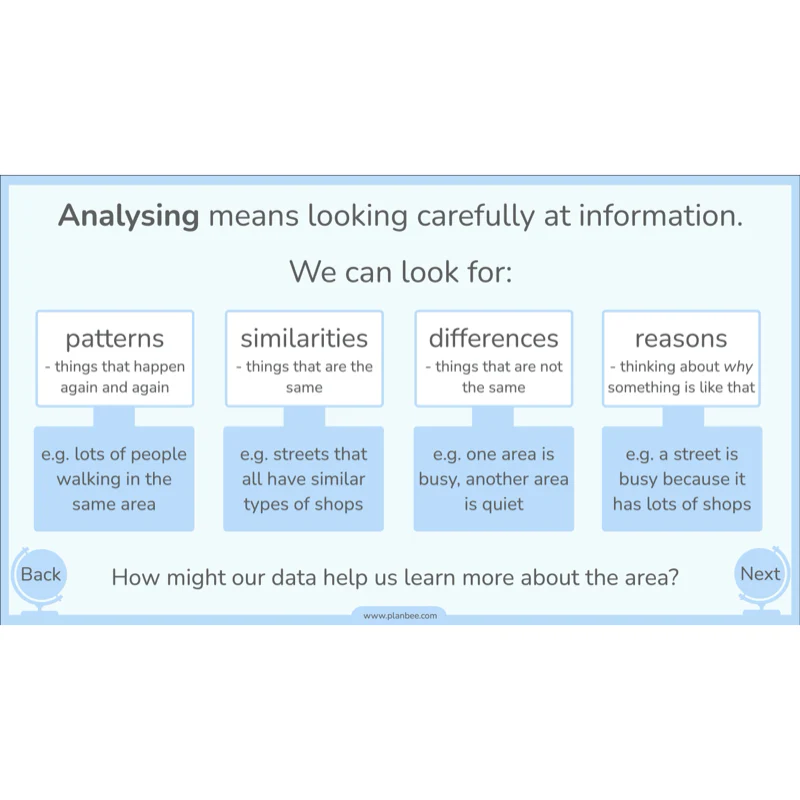
In this lesson, children analyse their fieldwork findings to understand how natural resources are used in their local area. They learn to identify patterns in land use and resource use, and explain why these patterns occur.
In their independent activities, children apply their understanding by interpreting their fieldwork data and explaining their conclusions, or by working collaboratively to prepare and present an explanation using evidence from their observations.
A detailed lesson plan, a set of engaging and informative PDF slides, differentiated activity ideas and printable resources are all included in this ready-to-teach KS2 Geography lesson pack.
What's included:
- Lesson plan
- Slides
- Activity ideas
- Analysis Sheets
- Presentation Planning Sheet
Lesson 7: Comparing Places
In this final lesson, children compare how natural resources are used in their local area with those in a contrasting place (coastal, rural or urban). They learn to identify similarities and differences in land use and resource use, and explain why these occur based on physical features, population and economic activity.
In their independent activities, children apply their understanding by comparing and explaining differences between places, or by working collaboratively to identify similarities and differences and justify their ideas using evidence from fieldwork and images.
This KS2 Geography lesson pack includes a detailed plan, a set of informative PDF slides for the teaching input, differentiated activity ideas and printable resources to support your class in their independent tasks.
What's included:
- Lesson plan
- Slides
- Activity ideas
- Photo Sheets
- Comparison Sheets
- Challenge Card
Natural Resources: Knowledge Organiser
This Year 5/6 Geography Knowledge Organiser has been created to complement our Geography Skills and Fieldwork strand. It is designed to support your children’s understanding of key vocabulary linked to this scheme of work. Key questions and relevant geographical skills have been identified to encourage children to apply their knowledge around this topic.
Original: $1.99
-65%$1.99
$0.70More Images


















Natural Resources
In this scheme, children learn what natural resources are and how they are used in everyday life. They explore how resources are distributed around the world and why countries trade to access what they need. Through fieldwork, children observe and record how natural resources are used in their local area, then analyse their findings to identify patterns and explain why they occur. Finally, they compare their local area with coastal, rural and urban environments, explaining how and why resource use differs between places.
Each of the seven fully prepared lessons comes with a detailed plan, a set of engaging and informative PDF slides for the teaching input, differentiated activity ideas and printable resources to support your class during their independent work.
A Knowledge Organiser is available to support the learning in this scheme. It is included in the Complete Series download or can be purchased individually.
Lesson 1: What are Natural Resources?
In this lesson, children are introduced to natural resources and learn how they are used by people. They explore different types of natural resources, including renewable and non-renewable, and begin to group them in different ways.
In their independent activities, children apply their understanding by identifying and classifying natural resources in a real-life environment, or in the alternative activity, compare and evaluate their importance through a ranking and discussion task.
This Natural Resources KS2 lesson pack includes a detailed plan, a set of informative PDF slides for the teaching input, differentiated activity ideas and printable resources to support your class in their independent tasks.
What's included:
- Lesson plan
- Slides
- Activity ideas
- Photo Card
- Information Card
- Differentiated worksheets
- Resource Cards and Discussion Stems
- Sorting Sheet
Lesson 2: Uneven Distribution
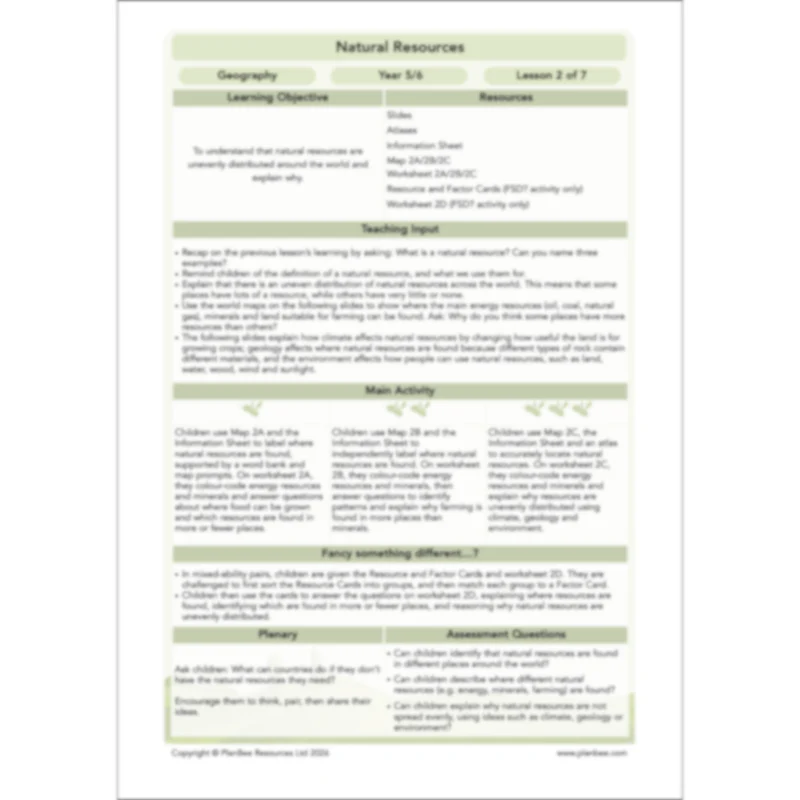
In this lesson, children explore how natural resources are distributed around the world and why they are not found everywhere. They learn about different types of resources and how factors such as climate, geology and environment affect where they are found.
In their independent activities, children apply their understanding by locating and analysing resource distribution on a world map, or by sorting and matching cards to explain patterns through discussion and reasoning.
This downloadable KS2 Natural Resources lesson pack has everything you need: an easy-to-follow plan, engaging PDF slides for the teaching input, differentiated activity ideas, including an alternative activity, plus printable resources.
What's included:
- Lesson plan
- Slides
- Activity ideas
- Information Sheet
- Map Sheets
- Differentiated worksheets
- Resource and Factor Cards
Lesson 3: Trade around the World
In this lesson, children learn why countries trade natural resources and how this is linked to the uneven distribution of resources around the world. They explore what different countries have and need, and how this leads to imports and exports.
In their independent activities, children apply their understanding by planning and explaining trade between countries, or by taking part in a trading activity to negotiate and justify trade decisions through discussion.
A detailed lesson plan, a set of engaging and informative PDF slides, differentiated activity ideas and printable resources are all included in this ready-to-teach KS2 Geography lesson pack.
What's included:
- Lesson plan
- Slides
- Activity ideas
- Differentiated worksheets
- Country Cards
- Trade Deal Cards
Lesson 4: UK Trade
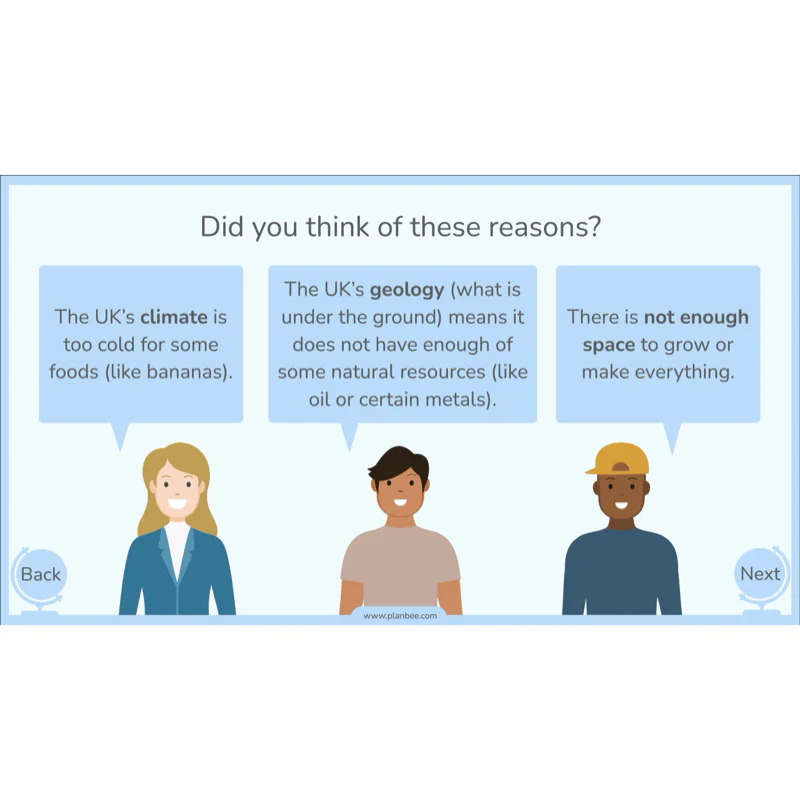
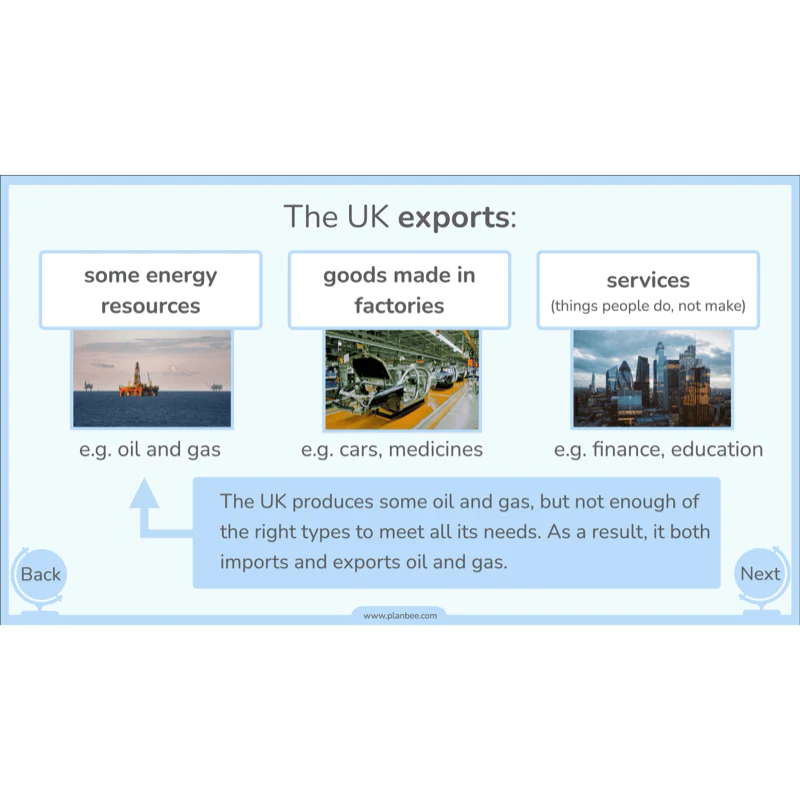
In this lesson, children learn about how the UK trades natural resources and why it relies on other countries. They explore what the UK imports and exports and how factors such as climate and availability affect this.
In their independent activities, children apply their understanding by explaining UK trade and its importance, or by discussing and justifying ideas about trade through structured group discussion.
This UK Trade KS2 lesson pack includes a detailed plan, a set of informative PDF slides for the teaching input, differentiated activity ideas and printable resources to support your class in their independent tasks.
What's included:
- Lesson plan
- Slides
- Activity ideas
- UK Trade Information Sheet
- Differentiated worksheets
- Discussion Cards
Lesson 5: Carrying out Fieldwork
In this lesson, children use fieldwork to explore how natural resources are used in their local area. They learn to identify different types of land use and observe how natural and human features are linked to the use of resources.
In their independent activities, children apply their understanding by recording observations in the local area, or by discussing and sorting photo cards to explain how natural resources are used in different places.
This downloadable KS2 Fieldwork lesson pack has everything you need: an easy-to-follow plan, engaging PDF slides for the teaching input, differentiated activity ideas, including an alternative activity, plus printable resources.
What's included:
- Lesson plan
- Slides
- Activity ideas
- Fieldwork Recording Sheets
- Teacher Notes
- Discussion Instruction Cards
Lesson 6: Analysing Fieldwork
In this lesson, children analyse their fieldwork findings to understand how natural resources are used in their local area. They learn to identify patterns in land use and resource use, and explain why these patterns occur.
In their independent activities, children apply their understanding by interpreting their fieldwork data and explaining their conclusions, or by working collaboratively to prepare and present an explanation using evidence from their observations.
A detailed lesson plan, a set of engaging and informative PDF slides, differentiated activity ideas and printable resources are all included in this ready-to-teach KS2 Geography lesson pack.
What's included:
- Lesson plan
- Slides
- Activity ideas
- Analysis Sheets
- Presentation Planning Sheet
Lesson 7: Comparing Places
In this final lesson, children compare how natural resources are used in their local area with those in a contrasting place (coastal, rural or urban). They learn to identify similarities and differences in land use and resource use, and explain why these occur based on physical features, population and economic activity.
In their independent activities, children apply their understanding by comparing and explaining differences between places, or by working collaboratively to identify similarities and differences and justify their ideas using evidence from fieldwork and images.
This KS2 Geography lesson pack includes a detailed plan, a set of informative PDF slides for the teaching input, differentiated activity ideas and printable resources to support your class in their independent tasks.
What's included:
- Lesson plan
- Slides
- Activity ideas
- Photo Sheets
- Comparison Sheets
- Challenge Card
Natural Resources: Knowledge Organiser
This Year 5/6 Geography Knowledge Organiser has been created to complement our Geography Skills and Fieldwork strand. It is designed to support your children’s understanding of key vocabulary linked to this scheme of work. Key questions and relevant geographical skills have been identified to encourage children to apply their knowledge around this topic.
Product Information
Product Information
Shipping & Returns
Shipping & Returns
Description
In this scheme, children learn what natural resources are and how they are used in everyday life. They explore how resources are distributed around the world and why countries trade to access what they need. Through fieldwork, children observe and record how natural resources are used in their local area, then analyse their findings to identify patterns and explain why they occur. Finally, they compare their local area with coastal, rural and urban environments, explaining how and why resource use differs between places.
Each of the seven fully prepared lessons comes with a detailed plan, a set of engaging and informative PDF slides for the teaching input, differentiated activity ideas and printable resources to support your class during their independent work.
A Knowledge Organiser is available to support the learning in this scheme. It is included in the Complete Series download or can be purchased individually.
Lesson 1: What are Natural Resources?
In this lesson, children are introduced to natural resources and learn how they are used by people. They explore different types of natural resources, including renewable and non-renewable, and begin to group them in different ways.
In their independent activities, children apply their understanding by identifying and classifying natural resources in a real-life environment, or in the alternative activity, compare and evaluate their importance through a ranking and discussion task.
This Natural Resources KS2 lesson pack includes a detailed plan, a set of informative PDF slides for the teaching input, differentiated activity ideas and printable resources to support your class in their independent tasks.
What's included:
- Lesson plan
- Slides
- Activity ideas
- Photo Card
- Information Card
- Differentiated worksheets
- Resource Cards and Discussion Stems
- Sorting Sheet
Lesson 2: Uneven Distribution
In this lesson, children explore how natural resources are distributed around the world and why they are not found everywhere. They learn about different types of resources and how factors such as climate, geology and environment affect where they are found.
In their independent activities, children apply their understanding by locating and analysing resource distribution on a world map, or by sorting and matching cards to explain patterns through discussion and reasoning.
This downloadable KS2 Natural Resources lesson pack has everything you need: an easy-to-follow plan, engaging PDF slides for the teaching input, differentiated activity ideas, including an alternative activity, plus printable resources.
What's included:
- Lesson plan
- Slides
- Activity ideas
- Information Sheet
- Map Sheets
- Differentiated worksheets
- Resource and Factor Cards
Lesson 3: Trade around the World
In this lesson, children learn why countries trade natural resources and how this is linked to the uneven distribution of resources around the world. They explore what different countries have and need, and how this leads to imports and exports.
In their independent activities, children apply their understanding by planning and explaining trade between countries, or by taking part in a trading activity to negotiate and justify trade decisions through discussion.
A detailed lesson plan, a set of engaging and informative PDF slides, differentiated activity ideas and printable resources are all included in this ready-to-teach KS2 Geography lesson pack.
What's included:
- Lesson plan
- Slides
- Activity ideas
- Differentiated worksheets
- Country Cards
- Trade Deal Cards
Lesson 4: UK Trade
In this lesson, children learn about how the UK trades natural resources and why it relies on other countries. They explore what the UK imports and exports and how factors such as climate and availability affect this.
In their independent activities, children apply their understanding by explaining UK trade and its importance, or by discussing and justifying ideas about trade through structured group discussion.
This UK Trade KS2 lesson pack includes a detailed plan, a set of informative PDF slides for the teaching input, differentiated activity ideas and printable resources to support your class in their independent tasks.
What's included:
- Lesson plan
- Slides
- Activity ideas
- UK Trade Information Sheet
- Differentiated worksheets
- Discussion Cards
Lesson 5: Carrying out Fieldwork
In this lesson, children use fieldwork to explore how natural resources are used in their local area. They learn to identify different types of land use and observe how natural and human features are linked to the use of resources.
In their independent activities, children apply their understanding by recording observations in the local area, or by discussing and sorting photo cards to explain how natural resources are used in different places.
This downloadable KS2 Fieldwork lesson pack has everything you need: an easy-to-follow plan, engaging PDF slides for the teaching input, differentiated activity ideas, including an alternative activity, plus printable resources.
What's included:
- Lesson plan
- Slides
- Activity ideas
- Fieldwork Recording Sheets
- Teacher Notes
- Discussion Instruction Cards
Lesson 6: Analysing Fieldwork
In this lesson, children analyse their fieldwork findings to understand how natural resources are used in their local area. They learn to identify patterns in land use and resource use, and explain why these patterns occur.
In their independent activities, children apply their understanding by interpreting their fieldwork data and explaining their conclusions, or by working collaboratively to prepare and present an explanation using evidence from their observations.
A detailed lesson plan, a set of engaging and informative PDF slides, differentiated activity ideas and printable resources are all included in this ready-to-teach KS2 Geography lesson pack.
What's included:
- Lesson plan
- Slides
- Activity ideas
- Analysis Sheets
- Presentation Planning Sheet
Lesson 7: Comparing Places
In this final lesson, children compare how natural resources are used in their local area with those in a contrasting place (coastal, rural or urban). They learn to identify similarities and differences in land use and resource use, and explain why these occur based on physical features, population and economic activity.
In their independent activities, children apply their understanding by comparing and explaining differences between places, or by working collaboratively to identify similarities and differences and justify their ideas using evidence from fieldwork and images.
This KS2 Geography lesson pack includes a detailed plan, a set of informative PDF slides for the teaching input, differentiated activity ideas and printable resources to support your class in their independent tasks.
What's included:
- Lesson plan
- Slides
- Activity ideas
- Photo Sheets
- Comparison Sheets
- Challenge Card
Natural Resources: Knowledge Organiser
This Year 5/6 Geography Knowledge Organiser has been created to complement our Geography Skills and Fieldwork strand. It is designed to support your children’s understanding of key vocabulary linked to this scheme of work. Key questions and relevant geographical skills have been identified to encourage children to apply their knowledge around this topic.